In the film Groundhog Day, Phil Connors (played brilliantly by Bill Murray) relives the same day over and over. No matter what he tries – being charitable, kind, loving or even attempting the ultimate escape through his own death – he awakes in the exact same place in the same condition on repeat. While we observe his challenges and thrills, his depression and, of course, the attempts to break free from the endless circle, a placid undercurrent permeates his experience. The source of this calm, and hence its comedy, rests in the lack of risk – he cannot be harmed, he does not age, and nothing he does alters the world around him come the morning reset. It is rumored the director, Harold Ramis, clashed with Bill Murray on the approach to the film: Ramis wanted to focus on the comedic aspects while Murray desired to explore the philosophical implications of living a day on repeat. Reflecting on the film, I find that they both won that argument; however, the clarity of it as a low stake world is only now obvious when, as so often is the case, a foil is presented.
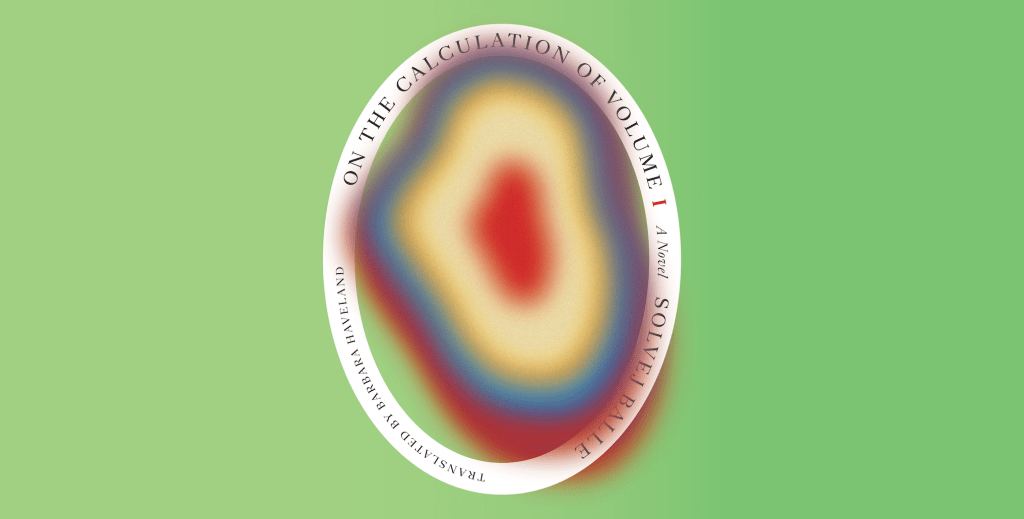
In Solvej Balle’s novel On the Calculation of Volume I (New Directions Publishing) we shed comedy for tragedy in a Groundhog Day flipped on its head. Tara Selter (the Phil Connors of this tale) is living November 18th on repeat but not reset in every aspect. The rules of the world, this loop, that Tara inhabits raise eyebrows and alarm bells. Tara is not repeating her same day; rather, she is living out life – presumably in perpetuity – on everyone else’s same day, slowly separating from the world around her. We learn almost immediately, through a burn she sustains on her first November 18th, that what happens to Tara stays with her even if the world around her does not. Some objects that she interacts with will stay with her day after day while others, with no apparent pattern, relocate back to their original location from the day prior. And no matter how much she tries, her husband, Thomas, (as with everyone else) always restarts the day with no recollection of the previous day’s activity.
Tara’s apprehension escalates to the untenable when she realizes that not only is she fragile, so is the world around her. She can and does take from the world – when she eats something it is permanently gone – a revelation that horrifies her. Tara recalls in her journal, “I have become a ravening monster, a monster in a finite world. A swarm of locusts. How long can my little world endure me.” For all its geographic vastness, a world that does not replenish and grow, that does not move forward is an unbalanced, symbiotically false, and insufficient place. The world around Tara wakes up with less and less every day, marching towards nothingness. A more chilling illustration of scarcity, I have never seen.
Balle places much of our focus on Tara’s desperate attempts to remain close to Thomas, with whom she spends several months investigating her predicament; however, the unavoidable pain of their divergent existences and futile attempts to break free becomes too much to bear. Remaining close after breaking contact, she moves, unbeknownst to him, into the guest room of their house. Proximity creates connection but with strings, hers limited to observation where actual engagement would break the spell, shattering their fragile dance. And then there is the direct impact Tara imposes on Thomas by merely staying close. She is sickened that she is responsible for making his world smaller – every visit to the grocery store and pass by their garden, Tara can tally her ravaging through ever barer shelves and their yard’s depleted vegetable plot. Stuck in a paradox of unsolvable connection and impact, she turns to the heavens to watch the moon and the stars, finding immediate solace in celestial objects that she could not possibly reach; however, as with the more immediate world around her, the ceaseless sameness in the positions of the clouds and night sky’s objects reduces her existence to an unmoving monotony. She is not small, growing to encompass even the universe above.
In an existence of time and space gone haywire, Tara is grounded only in the journal that she keeps, the journal through which we are told her story. Tara stretches and compresses her disconnect to the world (choosing the optimal proximity to her husband, the focus – or lack thereof – on her immediate environment) but eventually, without fail, she succumbs to her unmoored reality. But her anchor is her writing, the lifeline that proves she exists and has a history, an archive of time. With her hope and, possibly, sanity faltering, she naturally found a power in words, memorializing her existence. The poet Louise Glück found her writing carried a similar power. As she put it in a 2022 essay on her purpose for writing, “Those poems were me; they represented or embodied me. But, at the same time, they were not me; they were a thing apart that could be studied and adjusted and made perfect, as my actual self could not be.” Tara found a way to expand her world. And in creating a thing that was both her but distinct, she allowed for a living interaction that did not disappear the next morning.
Balle’s massive questions of existence, space and time, relationships, and connection spill forth in Tara’s intimate recounting of a life apart. And while the titular reference to volume makes sense, it’s through the density of those experiences that Balle foments chaos for Tara. Only through Tara’s memorialization can reflection and perspective live, only then does her humanity persist. Here we see the power of writing, existing above time and space, creating a world to be all its own.


 Sanford Moxley
Leave a comment